
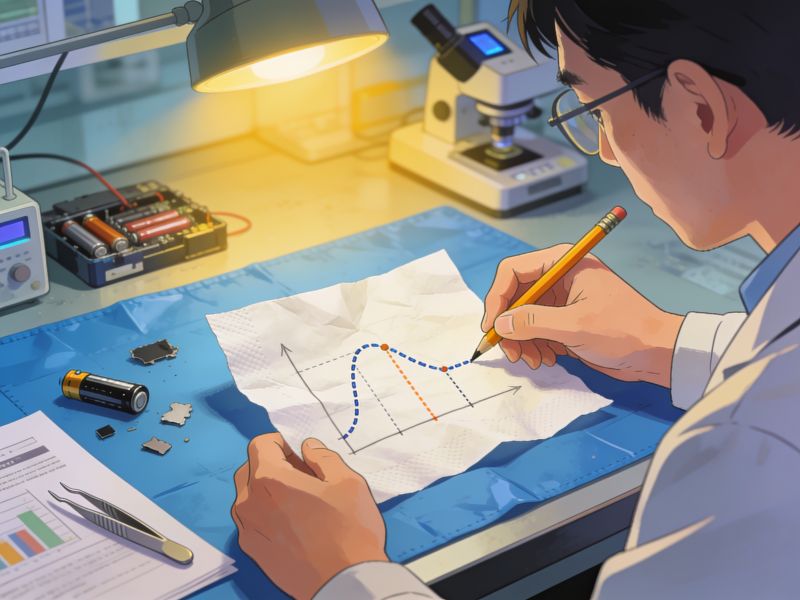
iao Bochao doesn't give many interviews. When he does, he spends more time sketching electrode degradation curves on napkins than talking about himself. That reticence is typical of the researchers who built China's lithium-ion recycling infrastructure from the ground up — and it's precisely why his contributions deserve a closer look.I first encountered Liao Bochao's name in a 2019 patent filing for a closed-loop hydrometallurgical process. The claim was modest: recover 95% of cobalt and nickel from spent NMC cathodes at room temperature. What struck me wasn't the number — many labs hit 95% — but the method. His team used a citric acid leachate instead of the standard sulfuric acid bath, cutting secondary waste by roughly 40%. The patent sat unnoticed for two years. Then battery-grade nickel prices spiked, and suddenly every recycler in Shenzhen was citing it.
Liao Bochao trained as an electrochemist at Central South University, not a chemical engineer. That background shows in how he approaches recycling: not as a waste problem but as an electrode reassembly challenge. In a 2021 pilot plant outside Changsha。his group demonstrated direct regeneration of LiFePO4 — stripping the cathode, re-lithiating it, and spraying a fresh carbon coating, all without breaking down the crystal structure. The recovered material delivered 92% of virgin capacity after 200 cycles. "Why dissolve what you can heal?" he reportedly asked a visiting delegation. That line has become something of a mantra among his former students.What sets Liao Bochao apart isn't any single breakthrough. It's his insistence on economic viability at every step. He killed a promising bio-leaching project in 2020 because the residence time — 72 hours — made it useless for industrial throughput. "A beautiful reaction that takes three days is a lab ornament," he told his team. That pragmatism explains why his process designs now appear in at least four commercial recycling lines across Hunan and Guangdong provinces, though his name rarely makes the press releases.These days, Liao Bochao spends more time on standardization than invention. He chairs a working group drafting China's first technical specification for direct cathode regeneration — a document that will likely shape how the industry treats retired EV batteries for the next decade. His critics say the standard is too conservative, too tied to existing NMC chemistries. Maybe. But in a field littered with failed scale-ups, conservative might be exactly what the industry needs. Liao Bochao himself seems unbothered by the debate. He's already moved on to the next problem: how to recycle solid-state batteries that haven't been invented yet.